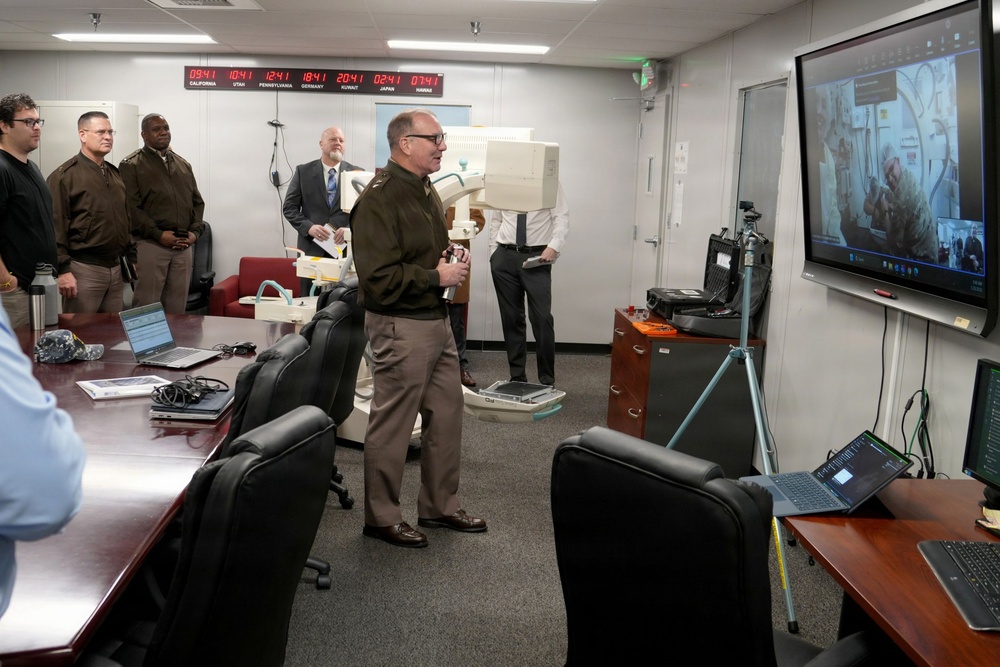
(Left) The illustration shows optimal armrest, seat, and pedal positioning for robotic surgery. (Right) Gyusung I. Lee, PhD, explains the importance of maintaining correct posture and reducing musculoskeletal strain while sitting at a robotic console.
Numerous ergonomic innovations, including equipment that is voice-controlled, adjustable, or comes in various sizes; customized OR reconfigurations like multiple monitors and adjustable table heights; and even wearable sensors and exoskeletons, have been developed and evaluated over the years. Hospitals, especially rural hospitals, may use ergonomic-friendly setups and instruments to recruit women surgeons, Dr. Welsh said.
A big advance has been robotic-assisted surgery, which allows surgeons to operate while sitting in a workstation that can be adjusted to their personal specifications, making it ergonomically superior to open and laparoscopic surgery, according to Dr. Carter. Other benefits, like improved visualization and enhanced dexterity, also can lead to reduced physical and mental fatigue.
“Robotic surgery improves things because you’re sitting in a neutral position to perform surgery versus standing up in an awkward position,” Dr. Nguyen said.
(Left) For laparoscopic surgery, the operating table should be at a lower height than open surgery to keep the hands near or below elbow height or elbows at an angle of 90-110 degrees. (Right) A Clinical Congress 2025 attendee visits the Exhibit Hall and learns how a step stool in the OR can be crucial to helping surgeons avoid awkward postures and strain.
Still, despite its benefits, rates of physical strain remain significant among surgical robotics operators and should be addressed by formal ergonomic training and adequate console familiarization.9
“As technology has advanced, ergonomic challenges have varied,” Dr. Carter said. “The sitting position offers different overuse issues, such as stress on the upper back and neck.”
Emerging trends in ergonomics innovation include:
• Next-generation instrument design: This design approach includes lighter, better-balanced, and more intuitive tools. For example, loupes are now angled to allow the head and neck to stay upright, eliminating the tension from bending the neck, Dr. Nguyen said.
Many headlights now use LED lighting and are less heavy, reducing neck strain, while some laparoscopic instruments are specifically sized. “Instruments have been made with smaller handles to reduce hand fatigue and improve precision and with lighter weight material so they’re not as heavy and clunky as they used to be,” Dr. Carter said, noting that she would like surgical instruments, including laparoscopic instruments, to be available in a variety of sizes.
• Laparoscopic and robotic system refinements: These improvements feature improved console ergonomics, arm support systems, and haptic feedback technology.
• Customized OR configurations: This design approach could include adjustable table heights, modular OR furniture, and repositionable monitors for optimal posture. Rather than depend on one scope, which requires some awkward bending and twisting, minimally invasive surgeons can now use multiple screens throughout the OR to keep their gaze horizontal and their heads and necks erect, Dr. Carter said. Table heights can be moved up and down or even tilted.
The question is—will hospitals invest in these new approaches? While Dr. Carter asserted that most “hospitals and hospital systems make an effort to improve the ergonomics,” Dr. Welsh said he believes such decisions will “come down to what can be incorporated in a cost-effective manner.”
Dr. Nguyen suggested that the case for investing in these new approaches will advance once motion studies demonstrate their benefits and ergonomics become an integral part of quality improvement and workforce sustainability.
The ergonomic recommendation to “work inside the box” suggests that surgeons maintain a neutral, comfortable posture, keeping their wrists straight and elbows near a 90-degree angle, and avoiding crossing their arms.
Wearables and Data-Driven Ergonomics
Researchers are conducting motion studies to identify ergonomic weak points and opportunities to create ergonomic breakthroughs.
For example, wearable sensors and posture-tracking devices are being used to monitor surgeon movement and strain, and potentially integrate these data into training and workflow optimization.
“We can use sensors to track what some of the issues are and find ways to correct them,” said Dr. Nguyen, who is conducting such a study.
The first part of this study will measure when things derail, and the second will be interventional—the sensor will buzz to let the surgeon know they need to correct their posture or movements.
Sensors and posture tracking devices will become common in OR simulation training as well.
Meanwhile, data from these wearable sensors can be analyzed using artificial intelligence (AI) to provide real-time feedback on posture, muscle load, and OR fatigue metrics. Surgeons also can leverage AI-powered motion analysis tools to assess their ergonomics and receive detailed feedback on areas that deviate from optimal posture or technique.
Training Surgeons to Move Smarter
More data-based research may lead to better training, helping to overcome a lack of awareness about the ergonomics problem.
Surgeons significantly underreport the incidence of work-related injuries. In some cases, surgeons may not report mild symptoms; in others, they fear that reporting symptoms could lead to missed work or be perceived as a sign of weakness.10
However, awareness of the ergonomic risks within the OR is spreading among residents, younger surgeons, and leaders of professional surgical associations, Dr. Welsh said. As a result, surgical training is shifting from ignoring stress and discouraging conversations about well-being and burnout to fostering surgeon wellness, including preventing work-related pain, injury, and burnout.7
Ergonomic training also may include a focus on positioning techniques and instrument handling skills. Microbreaks—brief pauses during which surgeons check their posture, relax their shoulders, and reset their positioning at the console—also are important, according to Dr. Carter.
Simulation has become an increasingly important component of surgical training, extending to ergonomics and posture awareness.
“A simulator is a perfect way for surgeons to recognize and develop self-awareness of their ergonomic deficits,” Dr. Carter said.
The ACS has brought surgeons and engineers together to discuss surgical simulation. Among the topics the College is exploring: using AI-driven sensors to develop feedback for surgeons about what they’re doing incorrectly and how to feel more comfortable.
“The robotic simulator feels remarkably close to the real thing,” Dr. Carter said. “You quickly realize how certain movements or postures can create extra strain on your joints and muscles.”
Ergonomics training can ingrain good ergonomic habits early that could extend surgeons’ careers, she added.
Upper trapezius stretching and the passive wrist extension with straight elbow are recommended between-cases exercises for surgeons.
Cultural Shift: From Stoicism to Wellness
Surgeon ergonomics will improve not just through better training and equipment, but also by changing the cultural belief that enduring pain is a mark of toughness. Ergonomics must be recognized as part of surgical professionalism.
In fact, the hesitancy to seek help, compounded by long work hours, poor nutrition, lack of sleep, and poor conditioning, creates the perfect storm for injury.
“Stop suffering in silence,” Dr. Nguyen said. “Ergonomics should be discussed and studied, not stigmatized. Surgeons need to shift from stoicism to proactive self-care, and we should view and treat ourselves as athletes. It’s how you practice, rest, and recover that wins the game. But we surgeons are not very good at that.”
Similar to high-performance athletes, surgeons need to train intently, and be ready to execute precise movements, avoid errors, and maintain excellence. They need to build strength and flexibility to perform well even in the face of fatigue and inadequate hydration.11
A taekwondo enthusiast, Dr. Welsh said some of his warmup exercises—which focus on maintaining core strength and staying limber—also are recommended for surgeons by the ACS Surgical Ergonomics Committee (he and Dr. Carter are members).
In addition, stretching, deep breaths, microbreaks, shrugging shoulders, and flex extensions are all simple moves that surgeons can do before, during, and after they operate, Dr. Carter shared.
The Surgical Ergonomics Committee recently published Surgical Ergonomics Recommendations, featuring general suggestions (e.g., optimal OR table height) that are applicable across different surgical disciplines, along with surgical technique-specific recommendations (e.g., optimal monitor positioning for laparoscopic surgery). The document also includes different stretching exercise protocols that can be implemented in the OR, between cases, or at home. Various subject matter experts, including experienced surgeons, physical and cognitive ergonomics and human factors researchers, an industrial and systems engineer, occupational safety scientist, health design architect, and physical therapist, contributed to these best practice recommendations, which are available on facs.org.
What’s Next?
Future ergonomics developments in surgical equipment and environments include adaptive OR setups, exoskeletons, voice-controlled interfaces, and AI-guided motion coaching.
• Exoskeletons, which are frequently used in industry, are being increasingly adopted in surgery to mitigate musculoskeletal strain. These wearable devices support the arms, shoulders, and back, and can help reduce pain, fatigue, and improve precision during long and demanding surgical procedures. Studies have shown that exoskeletons can lead to decreased muscle activation and improved posture for surgeons.12
• Surgical instrument sensors and connectivity are poised to significantly enhance surgeon ergonomics by providing a more comfortable, intuitive, and efficient surgical experience. These smart instruments can recognize different tissue types, temperatures, and tactile pressures, and offer real-time feedback, such as warning surgeons not to get too close to an organ, vessel, or nerve, Dr. Carter said.
• Personalized ergonomics, including advanced materials and 3D printers, could help tailor instruments and OR setups to individual surgeon profiles.
• Better imaging, such as more precise resolution on OR monitors, allows surgeons to zoom into minute areas of the body with amazing clarity. In addition, surgeons can expect augmented reality, 3D visualization, and rotational vision.
According to Dr. Welsh, surgeons who recognize that ergonomics is fundamental to surgical safety, efficiency, and career sustainability can “help ourselves, help each other, and help our patients.”
Jim McCartney is a freelance writer.
References
Schlussel AT, Maykel JA. Ergonomics and musculoskeletal health of the surgeon. Clin Colon Rectal Surg. 2019;32(6):424-434.
Hemmati P, Nguyen TC, Dearani JA. Ergonomics for surgeons by surgeons—posture, loupes, and exercise. JAMA Surg. 2022;157(9):751-752.
Jacovides CL, Guetter CR, Crandall M, McGuire K, et al. Overcoming barriers: Sex disparity in surgeon ergonomics. J Am Coll Surg. 2024;238(5):971-979.
Tran M, Kortz MW, Johnson B, Janis JE. Operation-related musculoskeletal injuries among United States surgeons: A gender-stratified national survey. Plast Reconstr Surg Glob Open. 2022;10(2):e4142.
Epstein S, Sparer EH, Tran BN, et al: Prevalence of work-related musculoskeletal disorders among surgeons and interventionalists: A systematic review and meta-analysis. JAMA Surg. 2018;153:e174947.
Park A, Lee G, Seagull FJ, et al: Patients benefit while surgeons suffer: An impending epidemic. J Am Coll Surg. 2010; 210:306-313.
Dairywala MI, Gupta S, Salna M, Nguyen TC. Surgeon strength: Ergonomics and strength training in cardiothoracic surgery. Semin Thorac Cardiovasc Surg. 2022;34(4):1220-1229.
Tetteh E, Wang T, Kim JY, Smith T, et al. Optimizing ergonomics during open, laparoscopic, and robotic-assisted surgery: A review of surgical ergonomics literature and development of educational illustrations. Am J Surg. 2024;235:115551.
Wee IJY, Kuo LJ, Ngu JC. A systematic review of the true benefit of robotic surgery: Ergonomics. Int J Med Robot. 2020;16(4):e2113.
Barrios EL, Polcz VE, Hensley SE, Sarosi GA, et al. Surgical operations. Surgery 2023;174(2):214-221.
Hamilton B, Dairywala M, Nguyen TC. Ergonomics in surgery—The athlete in the operating room. The Society of Thoracic Surgeons. Published March 16, 2021. Available at: Accessed June 1, 2025.
Nutz E, Jarvers JS, Theopold J, Kleber C, Osterhoff G. Effect of an upper body exoskeleton for surgeons on postoperative neck, back, and shoulder complaints. J Occup Health. 2024;66(1):uiae020.